Bea's Chosen Centuries-Old Chestnut Tree
Gente que viene y ¡Bah!Bea’s Chosen Centuries-Old Chestnut Tree is the living chestnut Bea chooses as the foundation and defining feature of a treehouse she hopes will help her recover after her wedding is called off. The tree first makes that future feel tangible: Bea sees a house fitting among its branches, then begins work nearby. Its later felling destroys not only the chosen building site but a project in which she had invested unusual hope. The dispute over the tree also exposes how family assumptions about ownership collide with a timber sale and the planned use of forest resources.
Selection and the Treehouse Plan
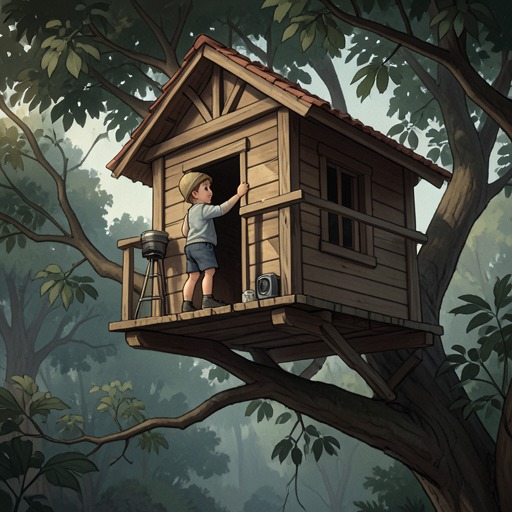
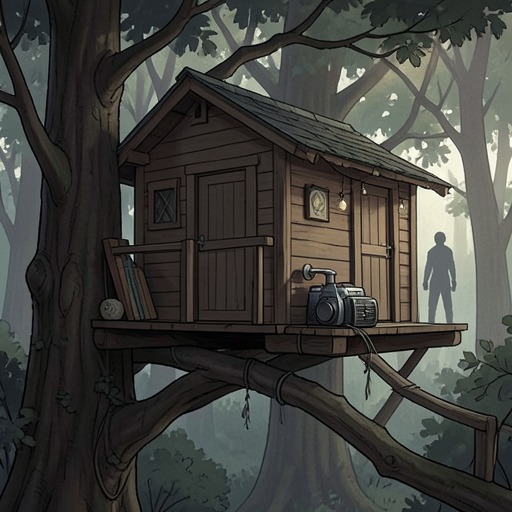
After reaching a stand of six chestnuts, Bea finds that three are rotten and dead, while the others remain in good condition. She chooses the best of the sound trees: a century-old chestnut with an exceptionally broad trunk and five sturdy branches extending almost horizontally. Its form makes the proposed structure seem achievable to her; she imagines a house resting among the branches, with a small terrace from which to look out over and feel part of the landscape.
The choice changes Bea’s mood. She feels genuinely happy for the first time in a long while, and her enthusiasm is noticeable to her brother-in-law. She asks to photograph and measure the tree and estimates that she can finish the plans in a week if she works intensively. Her confidence is directed toward a particular place and structure, not just an abstract idea of starting over: she has found a tree whose shape appears to accommodate the house she can already picture.
That sense of possibility is especially important in the weeks after the canceled wedding. Bea believes the treehouse will be what she needs to heal. The tree therefore becomes bound up with the project’s restorative promise, although the intended refuge is still only at the planning stage when the conflict over the woodland begins.
Building Begins
Bea prepares for construction with tools from her parents’ garage and equipment she has bought herself, including a circular saw, compressor, chainsaw, electric hammer, ladders, and parts for a small scaffold. She brings printed plans, a three-dimensional model on her laptop, and notes gathered from projects elsewhere. Her parents’ interest in furniture restoration has given her practical do-it-yourself knowledge, and she expects the work to bring relatives together around a shared task.
The first delivery makes the project’s physical demands plain. A truck from the sawmill can reach only the nearest forest track, leaving the pine boards to be carried roughly three hundred metres to the chestnut. Jacobo has arranged for three of his Guardia Civil colleagues to help. León, Jacobo, the sawmill employee accompanying the driver, and the three officers move the timber to the tree, where it is stacked by the end of the morning. Bea is already exhausted before construction has properly begun, but the materials are now gathered beside the site she chose.
The pine boards and the chestnut serve different roles in the project: the boards are building material, while the living tree is the structure’s intended setting and organizing centre. This distinction becomes sharply consequential when the same woodland is treated not as a collection of individual sites but as timber already sold for extraction.
Logging Rights and the Ownership Dispute
The tree’s vulnerability emerges against the disagreement over the San Esteban Biomass Plant. Débora condemns the biomass factory as a threat to the forests. Bea counters that the plant is intended to use wood residue, brush, and other organic waste, presenting forest clearance and biomass energy as a way to give neglected woodland a new use. Their exchange establishes that the proposed project has divided the family before the saws reach Bea’s tree.
When Bea returns to the chestnuts, two excavators are uprooting the rotten trees while workers with chainsaws are cutting living ones, including the century-old chestnut selected for her house. She runs toward the site and tries to stop a sawyer, telling him that the tree is private property and belongs to her family. The worker says the trees belong to the sawmill. A map locates the work about two hundred metres north of forest track seven and identifies the surrounding hectares as the sawmill’s timber. Some of the wood is intended for the biomass plant; usable timber is to be made into boards.
The apparent certainty of Bea’s claim is overturned by the contract. It records that Bea’s father sold the trees to the sawmill seven months earlier. The timber suitable for boards is to be paid for at an agreed rate, while the rest is designated for the biomass plant. The sawmill maintains that the purchase includes the right to extract the trees. Bea had believed the chestnuts remained her family’s, but that belief did not account for the sale or the rights attached to it.
Irene’s discussion of the transaction broadens the conflict beyond Bea’s individual building site. She argues that the landowners are being paid well for the timber and are also being offered money for the plot, which the buyers want for short-rotation forest crops. She presents public expropriation and conversion into public woodland as another possible route, though one that would not pay the owners as much as the Andrada family. The tree stands at the point where private sale, extraction rights, public ownership, and competing uses of the forest meet.
Felling and Aftermath
The tree is cut down before Bea can save it. When she returns, the chestnuts are lying on the ground, including the one beside which she had begun building. She has worked on the house for only a few days, and little of it has been constructed; nevertheless, she experiences the loss as if a completed building had been demolished. She compares it to imagining a future with someone and then having that future disappear. The comparison gives the tree’s felling its particular emotional weight: the loss is of a hoped-for life as much as of a physical site.
The family’s attempt to oppose the logging also ends in confrontation with the authorities. Bea’s siblings are handcuffed in a Guardia Civil van, while León shouts at the officers, the workers, and Jacobo. The treehouse plan, which Bea had imagined as a task that might unite relatives and help mend family wounds, instead becomes entangled with their arrest and anger.
In the end, the chosen chestnut is neither a completed treehouse nor a surviving refuge. It is the clearest measure of the gap between Bea’s intimate attachment to a specific place and the legal and commercial arrangements that had already made the woodland timber available for removal. Its fall turns a hopeful design project into a concrete loss, while revealing that the tree’s future had been decided through a transaction Bea did not know about.